Structural Drying in Gresham, OR
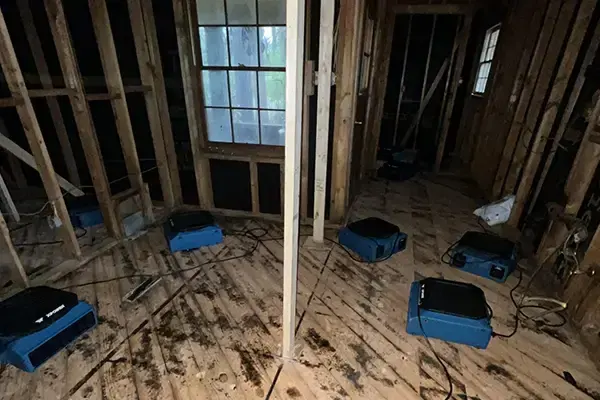
Wet framing, subfloor and wall cavities do not dry on their own in a damp Oregon winter. The drying team sets air movers and dehumidifiers to each room's load and reads the materials every day until they reach the goal.
(888) 373-8814Get the drying started in Gresham- 24/7 dispatch
- Daily moisture readings
- IICRC S500 standard
- Standard
- IICRC S500 drying goal
- Drying goal
- Within 2 to 4 points of a dry reference
- Equipment
- Air movers, LGR and desiccant units
- Documentation
- Daily readings and psychrometric logs
First steps for structural drying in Gresham
- 1Stop the water source
Drying cannot start while water is still coming in.
- 2Keep the heat on
Moderate indoor heat helps evaporation.
- 3Do not seal the room
Closed-up wet rooms trap humidity; let the equipment manage the air.
- 4Leave the equipment running
Turning units off overnight resets progress.
How structural drying is handled in Gresham, OR
Class sets the equipment
Class 1 through 4 sets how much equipment a room needs. A carpeted room with wet drywall needs far more airflow than a tile floor.
Cold air, different machines
Winter crawl spaces and unheated garages are too cold for refrigerant units to work well, so desiccant dehumidifiers take over.
Readings, not the calendar
The drying team logs moisture and humidity daily, and equipment leaves only when the materials read dry.
What does structural drying and dehumidification cost in Gresham, OR?
In Gresham, OR, structural drying typically runs $1,000 to $8,000 or more. The drivers are the number of rooms and the class of the loss, how many dehumidifiers and air movers are needed, how cold and damp the space is and how many days the equipment runs.
One or two rooms
- Air movers and one LGR
- Daily readings
- Three to four days
Several rooms or crawl space
- Multiple LGR units
- Containment tenting
- Wall cavity drying
Class 4 or cold spaces
- Desiccant dehumidifiers
- Hardwood and plaster drying
- Extended monitoring
Ranges only, not a quote. The drivers are the water category, the square footage, the material class and how fast drying started. For a planning number, try the water damage cost calculator.
The structural drying process, step by step
- 1
Map the moisture
The tech who does the walkthrough maps the wet area with pinless meters and thermal imaging before any equipment goes down, so the structural drying plan matches what is actually wet.
- 2
Extract and remove
The extraction crew pulls standing water with truck-mounted extraction, then removes only what cannot be dried, such as saturated pad, wet insulation or Category 3 drywall.
- 3
Dry to the goal
The drying team sets air movers and LGR dehumidifiers to the evaporation load of each room, adding desiccants when a cold crawl space or dense material calls for it.
- 4
Verify and document
Equipment comes out when readings land within 2 to 4 points of a dry reference, and the moisture map, daily logs and photos go into the claim file.
Why drying in Gresham takes a plan
From October to April the outdoor air in Gresham is cool and often close to saturated, so opening the windows does little to dry a wet house. Crawl spaces and garages can be too cold for refrigerant dehumidifiers to pull much water. Structural drying means building a closed drying environment: air movers push moisture out of the wet materials, and dehumidifiers pull it back out of the air, with the house kept warm enough for evaporation to happen.
Trade fact: IICRC S500 is the industry drying standard. Structural drying is finished when wet materials read within 2 to 4 points of a dry reference material in the same building, not when they look dry.
The equipment and what it does
- Air movers sweep air across wet surfaces to speed evaporation, placed according to the room's evaporation load.
- LGR dehumidifiers (low grain refrigerant) pull water out of warm air efficiently.
- Desiccant dehumidifiers keep working in cold crawl spaces and for Class 4 materials like hardwood and plaster.
- Injection and mat systems push dry air into wall cavities and pull water out of hardwood floors.
- Meters and thermal imaging confirm progress every day.
Drying follows extraction; see water extraction for the first step, and crawl space water damage for under-floor drying.
The drying log and the claim file
Each day the drying team records moisture readings on the wet materials and the temperature and humidity in the room. Those psychrometric logs show an adjuster that the equipment was needed and that the structure reached the goal. The EPA indoor air quality pages explain why drying within a day or two matters, and Oregon State University Extension covers home moisture control.
Structural Drying and Dehumidification across Gresham and nearby towns
The restoration team covers every Gresham ZIP and the surrounding east Multnomah County towns.
The restoration team works across Gresham, Troutdale, Fairview, Wood Village, Boring, Damascus, Happy Valley, Sandy and Corbett, from Johnson Creek to the Columbia.
97030970809723397236
See every neighborhood and town coveredStructural Drying and Dehumidification questions in Gresham, OR
Straight answers about structural drying in Gresham homes and businesses. For water that is still moving, call first and read later.
Call (888) 373-8814Why not just use fans and open windows?
In a Gresham winter the outside air is cool and damp, so it cannot absorb much moisture. Dehumidifiers in a closed space pull water out far faster than open windows.
How many machines does a room need?
It depends on the class of the loss and the room size. Class 1 through 4 sets the air mover and dehumidifier count for each room.
Why is the equipment so loud and warm?
Air movers move a lot of air, and dehumidifiers give off heat. The warmth actually helps evaporation.
Can I turn the equipment off at night?
It is best not to. Drying depends on steady airflow and dehumidification; turning units off lets humidity climb back up.
How do I know when it is dry?
The drying team compares daily readings on the wet materials to a dry reference in the same building. When they are within 2 to 4 points, the equipment comes out.
Is structural drying covered by insurance?
When the water loss itself is covered, drying is normally part of the claim, supported by the daily logs. Coverage depends on your policy, so check with your own insurer.
Structural Drying and Dehumidification in Gresham? Call now.
The longer water sits, the deeper it wicks into drywall, framing and subfloor. The restoration team handles structural drying 24/7 across Gresham and east Multnomah County.